Psychedelics, cannabis, 40 Hz light and sound, hyperbaric oxygen and the infection theories. What has actually been tested, what is still running, and who paid.
Last reviewed
16 min read
16 studies cited
Some of the most interesting ideas in Alzheimer’s research are here. So are some of the most expensive treatments with the least proof. This page treats both the same way: what was tested, in whom, how many people, and what happened.
Psychedelics: the real state of play
Interest in psychedelics for brain health is growing, and it rests on real biology. In animals, psilocybin (the active compound in “magic mushrooms”) acts on a serotonin receptor called 5-HT2A. That sets off a chain of signals that helps nerve cells grow new connections. In mice, new connections formed within 24 hours, and about a third of them (34% to 37%) were still there a month later. In pigs, a single dose raised the density of connections in the memory center. Cell studies also suggest it calms inflammation.
Those are good reasons to study it. They are not evidence that it helps people with dementia. The Alzheimer’s Drug Discovery Foundation, a nonprofit that reviews treatments, puts it simply: human research suggesting benefit for people with dementia is “none available”.
Psilocybin
The best-known trial is at Johns Hopkins. It gives people with mild cognitive impairment or early Alzheimer’s two guided psilocybin sessions with counseling, to see whether it eases depression. It is small and open-label, meaning everyone gets the drug and there is no placebo group. It started in 2020.
We cannot tell you where it stands. The Hopkins study page says it is recruiting. Penn Memory Center says it is not taking new people. A 2025 research summary listed its expected completion as September 2025. We found no published results as of September 2026.
Too early1/5Charity
Psilocybin for depression in early Alzheimer’s (Johns Hopkins pilot)
Garcia-Romeu A, Rosenberg P (lead investigators), Johns Hopkins; trial NCT04123314 Read the study
Design
Open-label pilot (everyone gets the drug; no placebo)
People
Planned about 20 (not yet confirmed)
Length
About 12 weeks of visits, with 3- and 6-month follow-up
Result No results published that we could find as of September 2026. The trial tests whether two guided psilocybin sessions ease depression in mild cognitive impairment or early Alzheimer’s. It does not test memory or disease slowing. Its status is unclear: the Hopkins page says “recruiting”, Penn Memory Center says it is not taking new people, and a 2025 research summary listed expected completion as September 2025.
Who paid: Not yet confirmed (reported as philanthropic and NIH-related)
Conflicts: Not reported
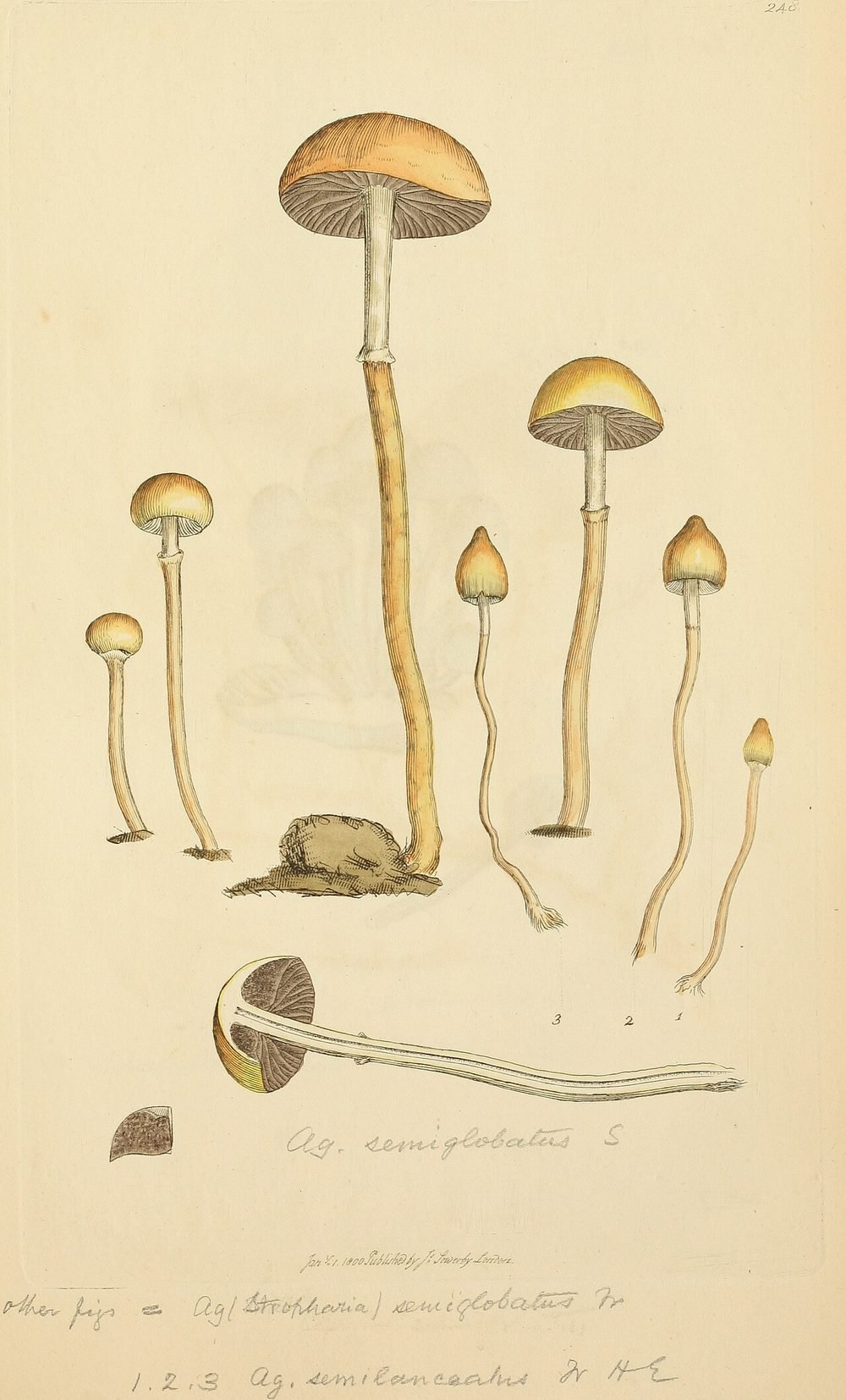
Plate 1.Sowerby’s 1800 plate. Figures 1–3 are the liberty cap, now called Psilocybe semilanceata.Public domainJames Sowerby, Coloured Figures of English Fungi, 1800. Via Wikimedia Commons.
Other trials are under way. One randomized trial is using brain scans to see whether psilocybin changes the density of nerve connections in people with amnestic mild cognitive impairment (NCT06041152), with completion estimated for July 2026. Early safety data have been presented at a conference but not yet confirmed in a published paper.
The 2026 case that went viral
In 2026 a medical journal published a report on one woman in her eighties who had lived with Alzheimer’s for 10 years. Outside any medical setting, she was given a large dose of mushrooms twice, a month apart. Her family reported that for a time she regained some continence, dressed herself, spoke more on her own and responded more to people.
Claim check
Too early
What’s being said
“Magic mushrooms brought a grandmother back from Alzheimer’s.”
Social-media posts sharing a 2026 case report
What the report actually shows
One person, no comparison group, and no standard memory or function tests. The changes were temporary. The authors themselves say it does “not imply disease reversal”. The dose was high by trial standards and unsupervised. A single case can suggest a question for a trial. It cannot tell a family what will happen to their own mother.
Too early1/5Public / nonprofit
One woman with advanced Alzheimer’s after psilocybin mushrooms
Case report, Frontiers in Neuroscience 2026 Read the study
Design
Single case report
People
1
Length
About 2 months (two doses a month apart)
Result A woman in her eighties, 10 years into Alzheimer’s, was given 5 grams of mushrooms outside any medical setting, then 3 grams a month later. Her family reported temporary gains in continence, dressing, speech and social contact. No standard tests were used. The authors say the case does not imply disease reversal.
Who paid: None reported
Conflicts: Not reported
LSD microdosing
“Microdosing” means taking a dose too small to cause a trip. A company called Eleusis, which is developing LSD for Alzheimer’s, ran a safety trial in 48 healthy older adults. Tiny doses every 4 days for 3 weeks were well tolerated. Headaches were more common, but thinking was not harmed. The trial did not include anyone with dementia and did not test for benefit. It tells us these doses seem safe in healthy people for a short time, nothing more. A 2026 review of microdosing in the general population suggests the mood and thinking benefits people report are largely placebo, but we have not been able to confirm its details.
Too early3/5Industry
Tiny doses of LSD in healthy older adults: a safety study
Result Placebo or 5, 10 or 20 micrograms of LSD. Side effects were no more common than on placebo except headache (17% to 50% of people on LSD vs 8% on placebo). No harm to thinking on computer tests. The study tested safety only; no one had dementia and no benefit was measured.
Who paid: Eleusis, a company developing LSD for Alzheimer’s
Conflicts: Company-funded, with company employees among the authors.
Ayahuasca, DMT and harmine
Ayahuasca is a South American brew. Its main compounds are DMT and harmine. A Spanish research group found that harmine and related compounds made brain stem cells grow and mature in a dish, and that DMT injected into mice increased new nerve cells in the memory center and improved memory tests. There are no studies in people with dementia.
Too early1/5Funder not confirmed
Ayahuasca compounds and brain stem cells in a dish
Morales-García JA et al., Scientific Reports 2017 Read the study
Design
Laboratory study (mouse cells in a dish)
People
None (cells only)
Length
Not applicable
Result Harmine and two related compounds from the ayahuasca vine made brain stem cells grow, move and mature. Cell studies are a first step, far from treatment.
Who paid: Not reported
Conflicts: Not reported
Too early1/5Funder not confirmed
DMT and new brain cells in mice
Morales-García JA et al., Translational Psychiatry 2020 Read the study
Design
Animal study
People
Mice (5 to 12 per group)
Length
Not applicable
Result Injected DMT increased new nerve cells in the memory center (hippocampus) and improved maze and object-memory tests in mice. No human dementia studies exist.
Who paid: Not reported
Conflicts: Not reported
Ibogaine
Ibogaine comes from the root of an African shrub. A Stanford study treated 30 male Special Operations veterans with traumatic brain injury, using ibogaine with magnesium to protect the heart. Treatment was given in Mexico. Disability, PTSD and depression improved a great deal, as did some thinking tests. There was no comparison group, and these were younger men with head injuries, not older adults with dementia.
Too early1/5Charity
Ibogaine with magnesium in veterans with brain injury
30 male Special Operations veterans with traumatic brain injury
Length
One treatment, with follow-up to 1 month
Result Large improvements in disability, PTSD, depression and some thinking tests (speed, planning). No serious side effects; magnesium was given to protect the heart. Treatment was given in Mexico. These were younger men with head injuries, not people with dementia.
Who paid: The VETS nonprofit paid for travel; other funding not reported in our notes
Conflicts: Not reported
MDMA
There is no evidence that MDMA helps dementia. Heavy recreational use is linked to memory problems, and it strains the heart and blood vessels, a concern in older adults. It is not a candidate treatment for dementia.
Ketamine and esketamine
Esketamine (Spravato), a nasal spray related to the anesthetic ketamine, is approved by the FDA for depression that has not responded to other treatment. It is not approved for dementia and is not a memory treatment. Reviews of its use in late-life depression suggest older adults tolerate it but respond less than younger adults, and that it can cause a detached, dreamlike feeling and rises in blood pressure. A 2026 pilot study tested a single ketamine infusion in older adults with depression and mild cognitive impairment, but we have not been able to read its results. Short-term studies generally show no lasting harm to thinking at treatment doses. Repeated long-term use in older adults has not been well studied.
Depression alongside dementia is worth treating in its own right. If it is a concern, ask the doctor about the options on our medicines page.
Cannabis for agitation
This is the most advanced area on this page. Agitation (restlessness, pacing, shouting, resisting care) is one of the hardest parts of later-stage dementia, and the drugs usually used for it carry serious risks. Several small randomized trials have now tested cannabis-type medicines.
Dronabinol
Dronabinol is a synthetic form of THC, the main active compound in cannabis, already approved for other uses such as nausea. A trial led by Johns Hopkins at 5 sites and paid for by the US National Institute on Aging gave 75 people with severe agitation 5 mg twice a day or placebo for 3 weeks, on top of their usual care. Agitation scores fell by about 30%, from 9.68 to 7.26 points. Scores on placebo did not change. No delirium or seizures were reported.
Promising3/5Public / nonprofit
Dronabinol (synthetic THC) for severe agitation
Johns Hopkins-led trial at 5 sites, American Journal of Geriatric Psychiatry 2025 Read the study
Design
Randomized, placebo-controlled trial
People
75 people with Alzheimer’s and severe agitation
Length
3 weeks
Result 5 mg twice a day, added to usual care, lowered agitation scores by about 30% (from 9.68 to 7.26 points on the Pittsburgh Agitation Scale). Scores on placebo did not change. Well tolerated; no delirium or seizures were reported.
Who paid: National Institute on Aging (NIH)
Conflicts: Not reported
Nabilone
Nabilone is another prescription drug that acts like THC. In a Canadian trial of about 39 people with moderate to severe Alzheimer’s, each person took nabilone and placebo in turn for 6 weeks each. Agitation improved more on nabilone, but sleepiness was more common. A larger Canadian follow-up trial appears to be finished, but we have not been able to confirm its main results.
Promising3/5Charity
Nabilone (a THC-like drug) for agitation
Herrmann N et al., American Journal of Geriatric Psychiatry 2019 Read the study
Design
Randomized crossover trial (everyone takes drug and placebo in turn)
People
About 39 people with moderate to severe Alzheimer’s (not yet confirmed)
Length
Two 6-week phases
Result Agitation improved more on nabilone than on placebo, as did overall behavior and caregiver distress. Sleepiness was more common on nabilone (about 45% vs 16%, not yet confirmed).
Who paid: Not yet confirmed (reported as the Alzheimer’s Drug Discovery Foundation and Alzheimer Society of Canada)
Conflicts: Not reported
CBD-rich oil
An Israeli trial tested a cannabis oil called Avidekel, which is 30% CBD and 1% THC, in 60 people with dementia for 16 weeks. Six in 10 on the oil had a meaningful drop in agitation, against 3 in 10 on placebo, and sleep improved. The oil’s maker paid for the trial. Two authors worked for the company and held stock options, and one holds the patent.
Promising2/5Seller conflict
CBD-rich cannabis oil (Avidekel) for agitation
Hermush V et al., Frontiers in Medicine 2022 Read the study
Result The oil was 30% CBD and 1% THC. 60% of people on the oil had a meaningful drop in agitation (at least 4 points), against 30% on placebo. Sleep improved. Sleepiness (49%), confusion (46%) and worse memory (32%) were common, but not significantly more than on placebo. Two deaths were judged unrelated.
Who paid: Tikun Olam, the maker of the oil
Conflicts: Two authors were company employees with stock options; one holds the patent.
CBD on its own is less promising. In healthy people, a single dose of CBD slightly impaired thinking. It can affect the liver and interacts with blood thinners such as warfarin, seizure medicines and anxiety drugs.
Weighing it up
An independent Cochrane review in 2021 pooled 4 trials with 126 people and found any effect on agitation too small to matter. It came out before the dronabinol and Avidekel results, so it is out of date. A 2026 pooled analysis has been published, but we have not yet read it.
Result Any effect on agitation was too small to matter in daily life, and the evidence was of very low to low certainty. Nabilone caused sleepiness. The review came out before the dronabinol and Avidekel trials, so it is out of date.
Who paid: Cochrane (independent)
Conflicts: Not reported
The main risk is falls. Across 46 trials in 6,216 adults over 50, products containing THC raised the rate of side effects about 1.4 to 1.6 times, mostly dizziness, drowsiness, dry mouth and poor coordination. Serious side effects did not increase. One hospital study of 274 older adults with serious falls found cannabis in 9.1% of them, but it was sleeping pills and opioids, not cannabis, that were linked to worse outcomes.
Too early4/5Funder not confirmed
Side effects of cannabis medicines in adults over 50
Result Products with THC raised the rate of side effects about 1.4 to 1.6 times, mainly dizziness, drowsiness, dry mouth and poor coordination, which the authors flag because of falls. CBD alone did not raise side effects, but only 4 studies tested it. Serious side effects did not increase.
Who paid: Not reported
Conflicts: Not reported
If a family is considering this, prescription dronabinol or nabilone has a known dose that a doctor can monitor. Shop-bought gummies and oils vary widely in how much THC they contain and are not regulated like medicines.
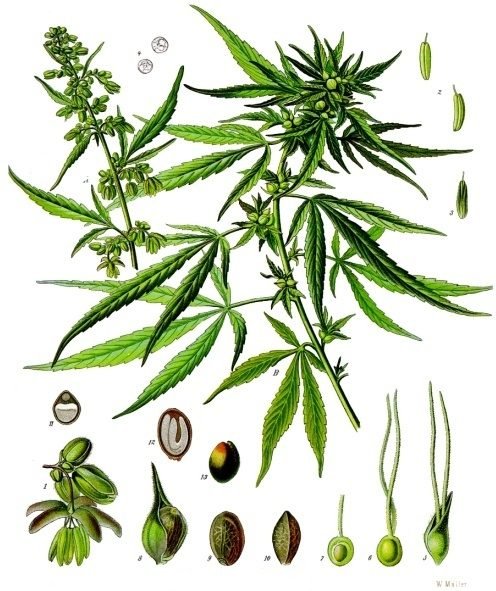
Plate 2.Cannabis, from Köhler’s Medizinal-Pflanzen.Public domainFranz Eugen Köhler, Köhler’s Medizinal-Pflanzen, 1897. Via Wikimedia Commons.
What’s legal in the US
No psychedelic is FDA-approved for dementia. Esketamine is approved for treatment-resistant depression. Dronabinol and nabilone are approved for other uses and are sometimes prescribed “off-label” for agitation.
Under federal law, psilocybin, LSD, DMT, ibogaine and MDMA are Schedule I drugs, meaning illegal outside approved research.
Oregon has allowed adults 21 and over to use psilocybin at licensed service centers since 2023. Facilitators do not have to be clinicians; it is a supervised adult-use model, not medical care.
Colorado has run a Natural Medicine program since 2025, with more than 30 licensed healing centers.
New Mexico passed a Medical Psilocybin Act in 2025. First patient access is targeted for December 2026, for listed conditions.
None of these programs was designed for people with dementia.
Cannabis is legal medically or recreationally in many states. Care homes set their own rules.
40 Hz light and sound
In 2016 an MIT team showed that light flickering 40 times a second (40 Hz) lowered amyloid plaque in the visual area of mouse brains. The idea is that it strengthens a brain rhythm called gamma. It led to a company, Cognito Therapeutics, co-founded by the lead MIT scientist, which makes a device that delivers 40 Hz light and sound. The device has an FDA “breakthrough” designation, which speeds review but is not approval.
The company’s first proper trial, OVERTURE, gave 76 people the device or a sham version for 6 months. It missed its main goals. Some secondary measures, such as brain volume, looked better. An independent lab also tried to repeat the mouse work and could not: the flicker did not produce the expected rhythms deep in the brain or lower plaque. In 2025 the MIT team reported on 5 people who had used the device for about 2 years. The 3 women with late-onset disease did better than comparison records; the 2 men with early-onset disease did not. Five people cannot settle anything.
Too early2/5Seller conflict
OVERTURE: 40 Hz flickering light and sound
Hajós M et al., Frontiers in Neurology 2024 Read the study
Design
Randomized, sham-controlled trial
People
76 people with mild to moderate Alzheimer’s
Length
6 months
Result Missed its main goals. Some secondary measures, such as brain volume, looked better in the treated group. A larger trial of about 670 people (HOPE) is due to report.
Who paid: Cognito Therapeutics, maker of the device
Conflicts: Company-run; authors are company employees.
Result An independent lab found that 40 Hz flickering light did not produce the expected brain rhythms deep in the brain, and did not lower plaque.
Who paid: Not reported
Conflicts: Not reported
The larger company trial, HOPE, with about 670 people, is due to report. That result will matter far more than anything so far. You can read about the lead scientist and her company ties on our experts page.
Infrared light and hyperbaric oxygen
Infrared light (photobiomodulation)
Photobiomodulation means shining red or near-infrared light at the head, usually through a cap or helmet, in the hope of helping brain cells. At least one well-known clinic chain sells a light cap for about $2,000. We did not find a controlled trial in people with Alzheimer’s whose results we could confirm, so we cannot give it a verdict. For more on the clinics that sell it, see alternative programs.
Hyperbaric oxygen
Hyperbaric oxygen therapy means breathing pure oxygen in a pressurized chamber. It is not approved for dementia. The research cited for dementia is a 2021 study that combined mice with a small group of patients and no comparison group. Blood flow in the brain improved in a few patients, and the mice had fewer plaques. The senior author co-founded Aviv Scientific, which sells hyperbaric treatment at Aviv Clinics. There is no controlled trial in people with Alzheimer’s.
Too early1/5Seller conflict
Hyperbaric oxygen in older adults and Alzheimer’s mice
Mouse study plus a small uncontrolled group of patients
People
Small number of patients (no control group), plus mice
Length
Not reported
Result Brain blood flow improved in a few patients, and mice had fewer plaques. There is no controlled trial in people with Alzheimer’s.
Who paid: Not reported
Conflicts: The senior author co-founded Aviv Scientific, which sells hyperbaric treatment at Aviv Clinics.
The infection theories
One long-standing idea is that germs, especially the cold-sore virus (herpes simplex), help trigger Alzheimer’s. On this view, amyloid plaque is partly the brain’s defence against infection. The evidence is mixed, and it points in a direction families may not expect.
Evidence for: the shingles vaccine
The strongest support comes from prevention, not treatment. In Wales, people just old enough to qualify for the shingles vaccine had 20% fewer new dementia diagnoses over 7 years than people just too old, in a natural experiment covering 282,541 adults. A second study found the newer shingles vaccine did better than the older one. Both are explained on our page on lowering your risk.
Evidence against: treating infection after symptoms start
The VALAD trial, paid for by the US National Institute on Aging, gave the herpes antiviral valacyclovir or placebo to 120 people with early Alzheimer’s who carried the herpes virus, for 78 weeks. It did not help. The people taking it declined faster on the main memory test than those on placebo.
Harmful4/5Public / nonprofit
VALAD: the herpes antiviral valacyclovir in early Alzheimer’s
120 people with early Alzheimer’s who carried herpes simplex virus
Length
78 weeks
Result The antiviral did not help. People taking it declined faster on the main memory test than people on placebo.
Who paid: National Institute on Aging
Conflicts: Not reported
A separate theory links Alzheimer’s to P. gingivalis, a bacterium involved in gum disease. A company called Cortexyme developed atuzaginstat to block the bacterium’s toxins and tested it in 643 people for 48 weeks. It missed both main goals. Liver problems led the FDA to halt the drug in 2022. Good dental care is still worth it for many reasons, but this drug did not work.
Didn’t work4/5Industry
GAIN: atuzaginstat against a gum-disease bacterium
Cortexyme GAIN trial, NCT03823404; results reported by the company in 2021 Read the study
Design
Randomized, placebo-controlled trial
People
643 people with mild to moderate Alzheimer’s
Length
48 weeks
Result The drug targets toxins from P. gingivalis, a bacterium linked to gum disease. It missed both main goals (thinking and daily living). A subgroup analysis claimed benefit in people with the bacterium in their saliva, but subgroup findings are not proof. Liver enzymes rose to more than 3 times normal in 7% (low dose) and 15% (high dose) of people. The FDA put the drug on full hold in January 2022 over liver safety.
Who paid: Cortexyme (the drug’s developer)
Conflicts: Company-run trial.
Put together, the vaccine findings are strong observational evidence, and treatment after symptoms start has failed so far. For more on this and the other theories of cause, see what Alzheimer’s is.
Questions to ask first
If a family member is drawn to something on this page, these questions help.
Has it been tested against a placebo or sham, in people with dementia, by someone who does not profit from it?
How many people were in the trial, and how long did it last?
Is there a trial my relative could join instead? Trials give close medical monitoring. See clinical trials.
Could it interact with the medicines my relative already takes, or raise the risk of a fall?