The habits with the best human evidence, ranked by how strong that evidence is. Plus the diets and programs that were tested properly and didn’t work.
Last reviewed
14 min read
17 studies cited
When a parent is diagnosed, the next thought is often “Will this happen to me?” Age and genes you can’t change. A good deal else you can. This page sticks to things that have been tested on people, and it tells you plainly when a test came back empty.
How to read this page
In 2024 the Lancet Commission, a panel of dementia experts, estimated that about 45% of dementia worldwide is linked to 14 risk factors people can change (read the Lancet Commission report). That is a modeled estimate for whole populations. It does not mean any one person can cut their own risk by 45%. It is also not a reason to blame a parent for their diagnosis. Many people who do everything right still get Alzheimer’s.
The 14 factors, by stage of life:
Early life: less education.
Midlife: hearing loss, high LDL (“bad”) cholesterol, depression, head injury, physical inactivity, diabetes, smoking, high blood pressure, obesity and heavy drinking.
Later life: social isolation, air pollution and untreated vision loss.
High LDL cholesterol (7% of cases in the Commission’s estimate) and untreated vision loss (2%) were added in 2024. We have not been able to confirm the Commission’s figures for the other twelve, so we leave them out.
The habits, ranked by evidence
Prevention habits ranked by strength of evidenceStrongest first. Verdicts come from the study cards further down.
Habit
Best evidence
Verdict
Blood pressure control
SPRINT MIND trial, 9,361 people
Solid
Regular exercise
2,724 trials pooled
Solid
Combined programs
FINGER and US POINTER trials
Solid
Hearing aids
ACHIEVE trial, higher-risk group only
Promising
Shingles vaccine
Two natural experiments
Promising
Speed training with boosters
ACTIVE trial, 20-year follow-up
Promising
Fixing cataracts
Large observational study
Promising
Treating sleep apnea
Named as a treatable cause of memory problems; no dementia-prevention trial we could confirm
Too early
Not smoking, less alcohol, staying social
On the Lancet list; no dementia trials
Sensible, untested
MIND or Mediterranean diet
Cohorts positive, MIND trial null
Too early
Blood pressure
High blood pressure damages the small blood vessels that feed the brain. Many people with Alzheimer’s also have this kind of vessel damage, which is one reason blood pressure keeps coming up. The best test so far is SPRINT MIND, a large trial that compared a strict target with a standard one.
Result Tighter blood-pressure control (a top number under 120 instead of under 140) cut new cases of mild cognitive impairment. The drop in dementia itself was not statistically significant, partly because the trial stopped early when the heart benefits became clear.
Who paid: National Institutes of Health (NHLBI, NIA, NIDDK, NINDS)
Conflicts: Not reported
The trial did not prove that tight control prevents dementia itself. It did show fewer cases of mild cognitive impairment, and the heart benefits alone were big enough to stop the trial early. The right target depends on age, falls risk and other medicines, so ask the doctor what fits. Two other items on the Lancet list sit close to this one: high LDL cholesterol and diabetes. A 2024 review found people with diabetes had a 65% higher chance of Alzheimer’s (read the 2024 diabetes and Alzheimer’s review).
Exercise
Exercise has more trials behind it than anything else on this page. The catch is that most measure thinking-test scores over months, not dementia diagnoses over decades.
Solid4/5Public / nonprofit
Exercise and thinking: 2,724 trials pooled
Singh B et al., British Journal of Sports Medicine 2025 Read the study
Design
Umbrella review of randomized trials
People
258,279 people across all trials
Length
Varied by trial
Result Exercise improved overall thinking, memory and planning skills across age groups. It measured test scores, not dementia diagnoses.
Result A year of walking grew the hippocampus (the brain’s memory center) by about 2%. The stretching group lost volume over the same year. Brain size on a scan, not dementia, was the outcome.
Who paid: National Institute on Aging
Conflicts: Not reported
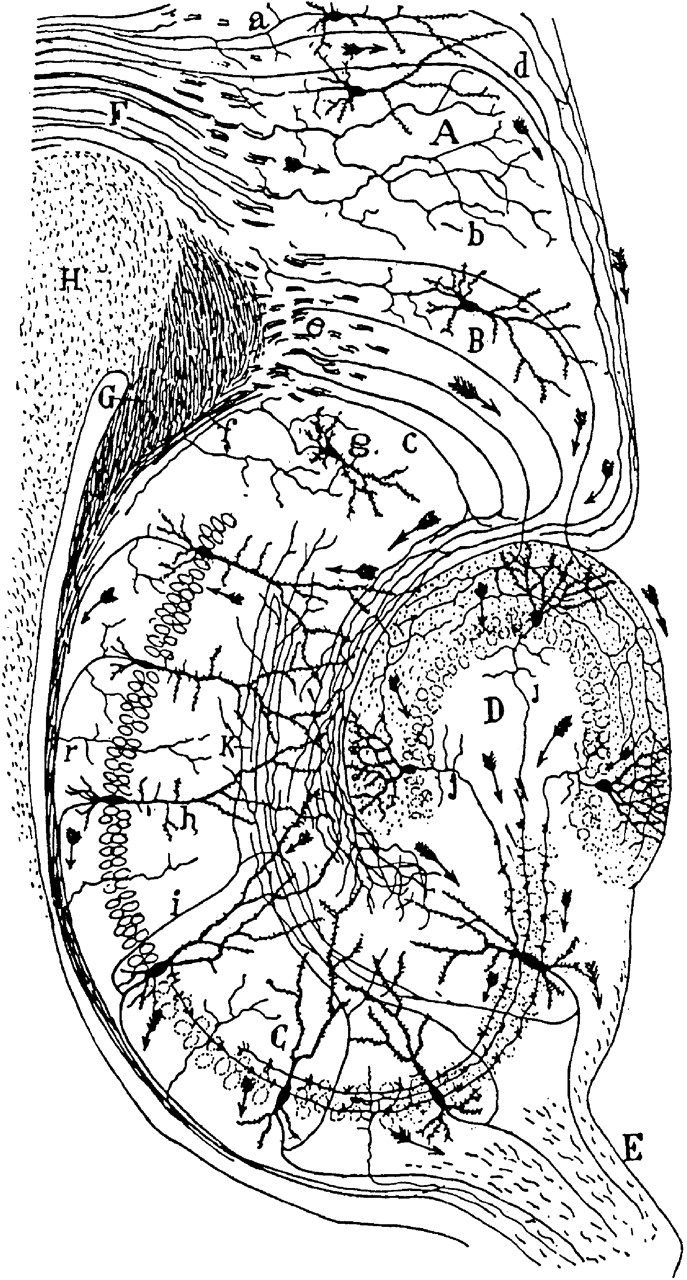
Plate 1.Cajal’s drawing of the hippocampus. Exercise studies measure this region because it holds new memories.Public domainSantiago Ramón y Cajal, 1911. Via Wikimedia Commons.
The EXERT trial is often reported as a failure. It is more interesting than that. People with mild memory loss were randomly given supervised aerobic exercise or supervised stretching. The two groups did the same, and neither declined over a year.
Didn’t work4/5Public / nonprofit
EXERT: aerobic exercise vs stretching in mild memory loss
Baker LD et al., Alzheimer’s & Dementia 2025 Read the study
Design
Randomized trial
People
296 people with mild cognitive impairment
Length
18 months
Result No difference between aerobic exercise and stretching. Neither group declined over 12 months, which is better than similar patients usually do. Any regular, supervised movement may be what counts, but with no do-nothing group this can’t be proven.
Who paid: National Institute on Aging; Brain Research Foundation
Conflicts: Not reported
Because EXERT had no group that did nothing, we can’t tell whether movement held people steady or whether the regular visits and attention did. The practical lesson is the same either way. Any regular, supervised activity is worth doing, and gentler forms count.
Combined programs: FINGER and POINTER
Instead of testing one habit, these trials bundle several: diet advice, exercise, brain training, social activity and checks on blood pressure and blood sugar.
Solid4/5Public / nonprofit
FINGER: diet, exercise, brain training and heart checks together
Result The combined program improved thinking scores compared with general health advice. People in the advice-only group were about 30% more likely to decline. The outcome was test scores, not dementia diagnoses.
Who paid: Academy of Finland, Finnish and Swedish government bodies, Alzheimer’s charities, Juho Vainio and Novo Nordisk foundations
Conflicts: Not reported
Promising4/5Charity
US POINTER: coached lifestyle program vs do-it-yourself
Result Both groups improved. The coached group improved slightly more, most of all in people who started with lower scores. There was no group that got nothing, so this compares two programs.
Who paid: Alzheimer’s Association
Conflicts: The US Highbush Blueberry Council gave the coached group monthly blueberry rebates.
Not every bundle has worked. Two large European trials came back empty.
Didn’t work4/5Public / nonprofit
preDIVA: nurse-led heart-risk care for people over 70
Moll van Charante EP et al., The Lancet 2016 Read the study
Design
Randomized trial
People
3,526 adults over 70, Netherlands
Length
6.7 years
Result No overall drop in dementia: 6.5% of the care group vs 7.0% of the usual-care group. People with untreated high blood pressure at the start who stuck with the program may have benefited, but that was a subgroup finding.
Result Neither omega-3 fish oil, nor a lifestyle program, nor both together slowed decline compared with placebo.
Who paid: French Ministry of Health; Pierre Fabre (maker of the omega-3) co-funded
Conflicts: Pierre Fabre, which made the omega-3 capsules, co-funded the trial.
Why did these fail? The papers don’t settle it. Our own guess is that the comparison groups were already fairly healthy and well cared for, which left little room to show a difference, or that the programs were too light. Either way, a nurse visit or a fish-oil capsule is no shortcut.
Hearing
Hearing loss is on the Lancet list. People who can’t follow a conversation tend to withdraw, and the brain may have to work harder just to decode sound. ACHIEVE tested whether fixing it helps.
Result No benefit overall. In the higher-risk group that the study planned in advance to look at separately, hearing care slowed thinking decline by 48%.
Who paid: National Institute on Aging
Conflicts: Not reported
The overall result was null. The benefit showed up only in the higher-risk group the researchers had planned to look at separately, which is more convincing than a subgroup found after the fact, but still a subgroup. Hearing aids help people hear and stay in conversations, which is reason enough. A hearing test is the place to start.
The shingles vaccine
This is one of the more surprising findings of recent years. Shingles comes from the chickenpox virus waking up again in older age. Two studies used quirks in who was offered the vaccine to compare otherwise similar people.
Promising4/5Public / nonprofit
Shingles vaccine and dementia: the Wales natural experiment
Natural experiment (birth-date cutoff for vaccine eligibility)
People
282,541 adults in Wales
Length
7 years
Result People born just late enough to qualify for the shingles vaccine had 20% fewer dementia diagnoses than people born just too early. The effect was stronger in women. This is about as close to a trial as observational data gets, but it is not a trial.
Who paid: National Institute on Aging; NIAID; Knight Initiative for Brain Resilience; Chan Zuckerberg Biohub
Conflicts: Not reported
Promising3/5Public / nonprofit
Newer shingles vaccine (Shingrix) vs the older one
Result People who got Shingrix had 17% more time free of a dementia diagnosis than people who got the older vaccine.
Who paid: NIHR Oxford Health Biomedical Research Centre
Conflicts: One author consults for GSK, which makes Shingrix. GSK was not involved in the study.
Neither study is a randomized trial, and no one yet knows why the vaccine would protect the brain. The vaccine does prevent shingles, which is painful, so it is a reasonable thing to ask the doctor about in its own right.
Eyesight
Untreated vision loss joined the Lancet list in 2024. Cataracts, the clouding of the eye’s lens, are common and fixable with a short operation.
Promising3/5Public / nonprofit
Cataract surgery and dementia
Lee CS et al., JAMA Internal Medicine 2022 Read the study
Design
Observational cohort
People
3,038 older adults with cataracts
Length
7.8 years
Result People who had cataracts removed had about 30% less dementia. Glaucoma surgery, which does not restore sight, showed no link. That points to better vision itself, but an observational study can’t prove cause.
Who paid: National Eye Institute; National Institute on Aging; Alzheimer’s Drug Discovery Foundation
Conflicts: Not reported
Processing-speed training, with boosters
Most “brain games” have little evidence behind them. One kind of training stands out. The ACTIVE trial compared three kinds of training in older adults: memory, reasoning and speed of processing (how fast the brain takes in and responds to what it sees).
Promising4/5Seller conflict
ACTIVE: speed-of-processing training, 20 years on
Coe et al., Alzheimer’s & Dementia: TRCI 2026 Read the study
Design
Randomized trial, long-term follow-up
People
2,021 older adults
Length
20 years
Result People who did speed training plus booster sessions had 25% fewer dementia diagnoses. Memory training and reasoning training didn’t help, and neither did speed training without the boosters.
Who paid: National Institute on Aging; National Institute of Nursing Research
Conflicts: A co-author consults for and owns stock in Posit Science, which sells the training as BrainHQ.
Two cautions. The benefit showed up only in people who did the booster sessions, and a co-author has a financial stake in the company that sells the training today. The trial itself was paid for with public money.
Sleep and sleep apnea
Sleep apnea means breathing stops and starts during sleep. Loud snoring, pauses in breathing, daytime sleepiness and morning headaches are the usual signs. The Alzheimer’s Association and the CDC list it among treatable conditions that can cause memory problems, and a sleep study can diagnose it.
Here is the honest part. We could not confirm a trial showing that treating sleep apnea, for example with a CPAP breathing machine, prevents dementia. Treating apnea is still worth doing for its own sake, and ruling it out is part of a good memory work-up. If a parent or partner snores heavily, ask about a sleep study.
Smoking, alcohol and company
Smoking, heavy drinking and social isolation are all on the Lancet list. None has a dementia-prevention trial behind it, and none is likely to get one, because you can’t randomly assign people to smoke or to be lonely. The evidence comes from long-term observation.
Smoking. Smoking harms blood vessels, including the ones that feed the brain. Ask the doctor about support to quit.
Alcohol. Heavy drinking can damage memory directly, and it drains thiamine (vitamin B1). Read about thiamine and memory on our nutrition and deficiencies page.
Company. Regular contact with other people keeps the mind busy. Clubs, volunteering, faith groups and regular calls all count.
Diet: the honest picture
People who eat a MIND or Mediterranean diet get dementia less often. The MIND diet (a blend of the Mediterranean diet and a blood-pressure-lowering diet) became famous because of one observational study.
Too early2/5Public / nonprofit
MIND diet and Alzheimer’s risk: the study that started it
Morris MC et al., Alzheimer’s & Dementia 2015 Read the study
Design
Observational cohort
People
923 older adults
Length
4.5 years
Result People who followed the MIND diet most closely had 53% less Alzheimer’s than those who followed it least. This study made the diet famous. A cohort shows a link, not cause.
Who paid: National Institute on Aging
Conflicts: Not reported
When the diet was finally tested head to head in a three-year randomized trial, it made no difference.
Didn’t work4/5Public / nonprofit
MIND diet, tested head-to-head
Barnes LL et al., New England Journal of Medicine 2023 Read the study
Design
Randomized trial
People
604 older adults
Length
3 years
Result No difference in thinking between the MIND diet and a usual diet when both groups cut calories slightly. Both groups improved about the same.
Who paid: National Institute on Aging
Conflicts: Not reported
Why the gap? People who choose to eat well also tend to exercise, smoke less, earn more and see doctors more. Cohort studies can’t fully separate those things. The trial could, and it found nothing extra from the diet. Both groups in the trial also lost a little weight, which may have helped everyone.
The Mediterranean diet has one small positive trial on thinking. It comes with baggage.
Promising3/5Industry
Mediterranean diet with extra olive oil or nuts (PREDIMED sub-study)
Valls-Pedret C et al., JAMA Internal Medicine 2015 Read the study
Design
Randomized trial (sub-study)
People
447 enrolled, 334 analyzed
Length
About 4 years
Result Extra olive oil improved overall thinking. Extra nuts improved memory. The low-fat control group declined. Many people dropped out of the analysis, and the parent trial had randomization problems.
Who paid: Instituto de Salud Carlos III (Spain); olive oil and walnuts donated by industry
Conflicts: Olive oil and walnuts were donated by producers. The main PREDIMED paper was retracted and republished in 2018 over randomization problems.
Our reading: a heart-healthy diet is still a good idea, because it helps blood pressure, cholesterol and blood sugar. The dementia-specific proof is weaker than most headlines say. For individual foods and supplements, read our nutrition and supplements guide.
What was tested and didn’t work
Null results are easy to miss because they rarely make the news. These were tested properly and showed no benefit for the main question asked.
Most of these were paid for with public money. That matters. Government-funded trials have little reason to bury a positive result, so when they come back empty, it is worth believing them.
Unproven extras
Some popular habits rest on a single observational study.
Result Men who used a sauna 4–7 times a week had about 65% less dementia than once-a-week users. Men only, one region, and healthier men may simply use the sauna more.
Who paid: Finnish Foundation for Cardiovascular Research
Conflicts: Not reported
Supplements are covered in detail on our nutrition page. The short version: a daily multivitamin has the best trial signal, and people with high homocysteine may benefit from B vitamins.
COSMOS: a daily multivitaminBaker LD et al., Alzheimer’s & Dementia 2022; Yeung LK et al., AJCN 2023 · 2,262 and about 3,500 · 2–3 years
Most prevention research looks at people before symptoms start. Once someone has Alzheimer’s, the aim usually shifts toward good days: comfort, connection and keeping everyday skills as long as possible. Several of these habits still help. Keep them moving, even with chair exercise or short walks. Make sure hearing aids and glasses are worn and working. Keep visits and calls going. Ask a pharmacist to review the medicine list, since some sleep aids and bladder drugs dull thinking. There is more on our living with Alzheimer’s page.
Words used on this page
Mild cognitive impairment (MCI)
Memory or thinking problems that are noticeable and measurable but don’t yet stop someone managing daily life. Some people with MCI develop dementia; some stay stable or improve.
Observational (cohort) study
Researchers follow a large group over time and see who gets ill. It can show a link between a habit and a disease, but not that the habit caused the difference.
Randomized trial
People are assigned by chance to a treatment or a comparison group, so the groups start out alike. This is the fairest test of whether something works.