Alternative programs, forum remedies and the lithium story
What families swap on forums, what the best-known alternative doctors recommend and sell, and what the studies behind them show.
Last reviewed
16 min read
9 studies in full, more linked
Most families try something outside the doctor’s office. A friend swears by coconut oil. A video says a spice blend or a pinch of lithium can stop the disease. This page takes those ideas seriously enough to check them. For each one we say what is claimed, what has been tested, and who makes money from it.
What families on forums say
Caregivers are sharp observers. They notice when someone sleeps better or smiles more. What one family can’t tell is whether the change came from the remedy, a good week, or something else that changed at the same time. That is what controlled trials are for. Below are the tips we saw most often on caregiver forums, each matched to the best evidence we could find.
Where we looked: ALZConnected (the Alzheimer’s Association forum), AgingCare, the UK Alzheimer’s Society forum, and ApoE4.info. We could not read Reddit or Facebook groups for this page, so nothing here is drawn from them.
Common forum tips, checkedVerdicts use this site’s scale. “More” links go to the evidence.
Tip
Verdict
What the evidence shows
More
Music and familiar playlistsEverywhere
Promising
A 2025 Cochrane review of 30 studies (1,720 people) found music therapy probably lifts mood a little. No clear effect on agitation or memory. Effects fade when sessions stop.
The ACHIEVE trial (977 people, 3 years) found no benefit overall. In a higher-risk group of 238 people, thinking declined 48% more slowly with hearing care. Hearing aids also help conversation.
Reviewing “PM” sleep aids, Benadryl-type and bladder pillsFamily and pharmacist advice
Promising
Long-term use of these “anticholinergic” drugs is linked with confusion and dementia risk in observational studies. Never stop a prescribed drug suddenly. Ask for a medication review.
Retail gummies vary widely in strength. CBD can affect the liver and interacts with blood thinners and seizure medicines. Small trials of prescription THC-type drugs for agitation look more hopeful.
Coconut oil or MCT oilLong-running forum and blog theme
Too early
A pooled look at 10 small trials (848 people) hints at a small benefit, mainly in people without the APOE4 gene. The largest MCT trial failed. Diarrhea is common.
A 30-person trial in mild memory loss raised scores, which fell back 4 weeks after stopping. A 49-person trial in mild Alzheimer’s found no benefit to thinking.
Study details for music, hearing, lion’s mane and anticholinergic drugs are on the linked pages and in the study database.
Music-based therapy for people with dementiavan der Steen JT et al., Cochrane Database of Systematic Reviews 2025 · 1,720 people, mostly in nursing homes · Five or more sessions
Lion’s mane extract in mild Alzheimer’sLi IC et al., Frontiers in Aging Neuroscience 2020 · 49 people with mild Alzheimer’s enrolled (41 in the main analysis) · 49 weeks
Too early1/5Seller conflict
The prevention crowd: ApoE4.info
ApoE4.info is a patient-run community for people who carry the APOE4 gene, which raises Alzheimer’s risk. Most members have no symptoms and are trying to prevent the disease. The thread titles we could see were about ketogenic diets, measuring ketones, the Bredesen protocol, and whether saturated fat is safe for gene carriers. We could see titles but could not open the threads, so we can only describe the topics. It is a highly engaged, self-experimenting group, and much of what it tests has not been tried in formal studies.
Alternative and integrative programs
These are the names families meet most often in books, podcasts and ads. Many give sensible advice about sleep, exercise and blood sugar, and much of it matches the mainstream evidence on our lowering-your-risk page. Most also sell tests, programs or supplements. One question cuts through the marketing: has this exact program been tested against a control group, by someone who doesn’t profit from it?
Alternative programs at a glanceEvidence strength is for the program as sold, on this site’s 1–5 scale.
Monthly plans, blood testing, practitioner training
2/5
OrnishLifestyle medicine
Plant-based diet, exercise, stress management, group support
Licensed lifestyle program
3/5
SherzaiNEURO plan
Plant-based diet, exercise, stress, sleep, mental and social activity
Books, online courses
2/5
Perlmutter
Low-carb eating, no gluten, lower uric acid, gut health
Books, courses, recommended products
2/5
HymanFunctional medicine
“Root-cause” work on gut, inflammation, toxins, sleep; supplements
Supplements, programs, lab testing
2/5
Life Extension
A long list of supplements
Most of those supplements
2/5
Amen Clinics
SPECT brain scans to “type” problems; supplements
Scans and evaluations, about 95 supplements
1–2/5
Mercola
Wide-ranging natural-health advice
Supplements and devices
1/5
A neutral place to check any supplement
The Cognitive Vitality ratings from the Alzheimer’s Drug Discovery Foundation (ADDF) are free and written by neuroscientists. Each supplement, food or drug gets a rating for evidence, likely benefit and safety, including known drug interactions. The foundation sells no supplements. It does invest in drug development, which is worth knowing. When a program recommends a supplement, looking it up there takes two minutes.
Dale Bredesen and the ReCODE protocol
What it recommends. A personalized plan built on lab tests. The program says more than 36 factors drive decline. It uses a mildly ketogenic, plant-rich diet called KetoFLEX 12/3, with a 12-hour overnight fast, plus exercise, sleep, many supplements, and hormone and toxin work-ups.
What it sells. Apollo Health, where Dr. Bredesen is chief science officer, lists PreCODE at $39.95 a month and ReCODE at $75 a month, a blood-testing panel, meal kits through a partner, coaching, and practitioner certification ($1,495 for coaches, $2,495 for practitioners). Lab tests, supplements and practitioner fees come on top.
What the evidence shows. The first reports were small case series with no comparison group. In 2020 a UCSF neurologist, Joanna Hellmuth, reviewed them in Lancet Neurology. She found no controls, no randomization, missing information on people who didn’t improve, and an unvalidated questionnaire (read her critique). Apollo has published a rebuttal. A 2022 pilot of 25 people also had no control group. Apollo describes a 2025 randomized trial that is posted only as a preprint, not yet peer reviewed, and claims it beat the drug Leqembi. That comparison sets two different trials in different people side by side, which is not a like-for-like test.
Many parts of the protocol, such as exercise, sleep, and blood-sugar and blood-pressure control, match mainstream advice. The full package has not been tested in an independent, adequately sized trial with a control group.
Too early1/5Seller conflict
“Reversal of cognitive decline”: the first Bredesen case series
Result 9 of 10 patients were reported to improve on a personalized program of diet, sleep, exercise, supplements and hormone work. With no comparison group, it cannot show what caused the change. The program later became ReCODE and the book The End of Alzheimer’s.
Who paid: Not reported
Conflicts: Dr. Bredesen is now chief science officer of Apollo Health, which sells programs based on this protocol.
Too early2/5Seller conflict
ReCODE precision-medicine pilot
Toups K et al., Journal of Alzheimer’s Disease 2022;88(4):1411–1421 Read the study
Design
Single group, no control group
People
25 with mild cognitive impairment or early Alzheimer’s
Length
9 months
Result Average scores on a short memory test (MoCA) rose from 24.6 to 27.6 out of 30. Because everyone got the program and nobody was compared with a control group, there is no way to tell how much came from the protocol.
Who paid: Four Winds Foundation and private donors
Conflicts: Dr. Bredesen is chief science officer of Apollo Health, which sells ReCODE.
Dean Ornish and the lifestyle trial
What it recommends. An intensive whole-food, plant-based diet, daily exercise, stress management and group support. Dr. Ornish’s program for heart disease has been covered by Medicare as intensive cardiac rehab since 2010.
What the evidence shows. This is the only program on this page with a peer-reviewed randomized trial in people with memory problems. It was small (51 people), short (20 weeks), and nobody could be blinded to a diet change. Some measures favored the lifestyle group, and one standard memory test just missed. A critique titled “the need for rigor” was published in the same journal; we were not able to read it in full. One of the co-authors is Miia Kivipelto, who led the FINGER prevention trial. A larger trial would settle a lot.
Promising3/5Seller conflict
Ornish intensive lifestyle program in early Alzheimer’s
Ornish D et al., Alzheimer’s Research & Therapy 2024 Read the study
Design
Randomized trial; participants knew which group they were in
People
51 enrolled, 49 completed; mild cognitive impairment or early Alzheimer’s
Length
20 weeks
Result A whole-food plant-based diet, exercise, stress management and group support. On a clinician’s overall rating, 10 of 24 in the lifestyle group improved vs 0 of 25 controls. Two dementia rating scales also favored the lifestyle group. A standard memory test (ADAS-Cog) just missed significance. Small, short, and registered after it started.
Who paid: Private donors. The paper says sponsors had no role in the study.
Conflicts: Dr. Ornish holds equity in Ornish Lifestyle Medicine, which sells the program.
Dean and Ayesha Sherzai
Two neurologists who describe themselves as directors of the Alzheimer’s Prevention Program at Loma Linda University Medical Center. We could not confirm whether that is current. Their plan, called NEURO Resolution, is reported to cover whole-food plant-based eating, exercise, stress, sleep, and mental and social activity. They sell books, online courses and the program; we could not open their site to confirm details or prices. Each part lines up with mainstream risk-factor evidence. We found no trial of their program as a whole.
David Perlmutter
A board-certified neurologist and author of Grain Brain, Drop Acid and Brain Defenders. He recommends low-carb or ketogenic eating, avoiding gluten, lowering uric acid and caring for gut bacteria. He sells books and courses and links recommended products. Good evidence ties diabetes and insulin resistance to dementia risk. There is no trial evidence that going gluten-free prevents dementia in people without celiac disease, and the role of uric acid is debated.
Mark Hyman
A functional-medicine doctor who recommends “root-cause” work on gut, inflammation, toxins and sleep, plus fish oil, magnesium and vitamin D. He also mentions treating hearing loss. He sells supplement stacks, including a memory formula, and co-founded the Function Health lab-testing company. His advice on sleep and hearing is reasonable. The supplements he names mostly have weak evidence (see our nutrition page).
Claim check
Not what the trials tested
What’s being said
“Alzheimer’s Is Reversible – Here’s Proof.” Lifestyle trials show you can “not just slow” the disease “but reverse” it. “This is published data.”
Mark Hyman on The Tucker Carlson Show. The quoted words are from his December 2024 interview; a clip reported as posted May 22, 2025 carries the title.
What the studies actually show
The two trials he pointed to, FINGER and US POINTER, enrolled older adults who did not have dementia. Both found small improvements on thinking tests. Neither tested people with Alzheimer’s, and neither showed reversal. POINTER’s results were not yet published when he called it published data; they came out in July 2025. The other “proof” he gave was Richard Isaacson’s clinic study (no randomized control group, mostly people without dementia), Dale Bredesen’s book, and his own patients. The closest thing to a reversal trial is Dean Ornish’s 2024 study of 51 people over 20 weeks, covered above.
Hyman made the claim while describing Alzheimer’s blood tests from Function Health, a company he co-founded; he disclosed that on air.
ReCODE precision-medicine pilotToups K et al., Journal of Alzheimer’s Disease 2022;88(4):1411–1421 · 25 with mild cognitive impairment or early Alzheimer’s · 9 months
Too early2/5Seller conflict
Life Extension
A supplement company whose Alzheimer’s “protocol” lists huperzine A, lion’s mane, lipoic acid, acetyl-L-carnitine, ginseng, vitamins C and E, DHA, phosphatidylserine, B vitamins, ginkgo, curcumin, vinpocetine, PQQ and grape seed. The page itself says that many of these therapies are debated. The company sells most of them. Huperzine A works the same way as donepezil (Aricept), rivastigmine and galantamine. Never take it with them: side effects such as nausea, a slow heartbeat and fainting add up.
Daniel Amen and Amen Clinics
A psychiatrist whose clinics use SPECT brain scans to sort patients into “types”. According to McGill University’s Office for Science and Society, an initial evaluation runs about $3,000 to $4,000. The company also sells about 95 supplement products, courses, an infrared light cap (about $2,000) and hyperbaric oxygen (read McGill’s review). McGill notes that the American Psychiatric Association and the National Institute of Mental Health do not endorse SPECT for diagnosing psychiatric conditions or choosing treatment, and that no rigorous controlled trial of the Amen approach exists. Mainstream memory clinics do sometimes use SPECT or PET scans to help tell one type of dementia from another. That is a much narrower use.
Joseph Mercola
An osteopathic physician whose website sells supplements and devices. The FDA sent him repeated warning letters between 2005 and 2021 over illegal disease claims for products, including coconut oil. In 2016 he settled with the Federal Trade Commission over tanning-bed claims, paying $2.6 million in refunds. If a remedy comes from this source, check it against the Cognitive Vitality ratings first.
Richard Isaacson
A neurologist known for “preventive neurology”: individual risk-reduction plans for people with a family history, based on genetics, lab tests and lifestyle. He is widely reported to have founded the Alzheimer’s Prevention Clinic at Weill Cornell and to have moved to the Institute for Neurodegenerative Diseases in Florida. We have not yet confirmed his current role, his studies or his commercial ties, so we don’t grade his work here. His general approach sits close to mainstream prevention advice.
Claim check: the brain-health spice blend
A daily “brain health spice blend” is making the rounds on social media. The recipe being shared is turmeric, ginger, cinnamon, cayenne, black pepper and honey, with no amounts given.
Plate 1.Turmeric, whose root gives curcumin.Public domainFranz Eugen Köhler, Köhler’s Medizinal-Pflanzen, 1897. Via Wikimedia Commons.
Claim check
Too early
What’s being said
A morning mix of turmeric, ginger, cinnamon, cayenne, black pepper and honey protects the brain.
Our paraphrase of a widely shared social-media recipe
What the studies actually show
No human trial has tested any spice blend for dementia. The research on single ingredients is thin:
Curcumin (from turmeric). One small trial of 40 adults without dementia used a specially absorbed form, Theracurmin, at 90 mg twice a day for 18 months, and found better memory and attention. Regular curcumin at 2 to 4 g a day did nothing in a 36-person Alzheimer’s trial, and barely any reached the blood.
Cinnamon. A 2023 review found 40 studies, and only 2 were in people. Those 2 disagreed.
The blend is fine as food. It is not a proven treatment. Concentrated curcumin supplements can interact with some medicines, so mention them to the doctor.
In August 2025, Bruce Yankner’s lab at Harvard Medical School published a paper in Nature that set off a wave of social-media videos. It found lithium levels were lower in the brains of people with memory loss. In mice, a tiny dose of lithium orotate nearly prevented plaques and restored memory. No person was given lithium in the study.
Lithium is a natural element. Prescription lithium carbonate is a long-used psychiatric medicine, given at much higher doses. Tiny amounts occur in tap water. Over-the-counter lithium orotate sits in between. The evidence for each level is different, so it helps to take them one rung at a time.
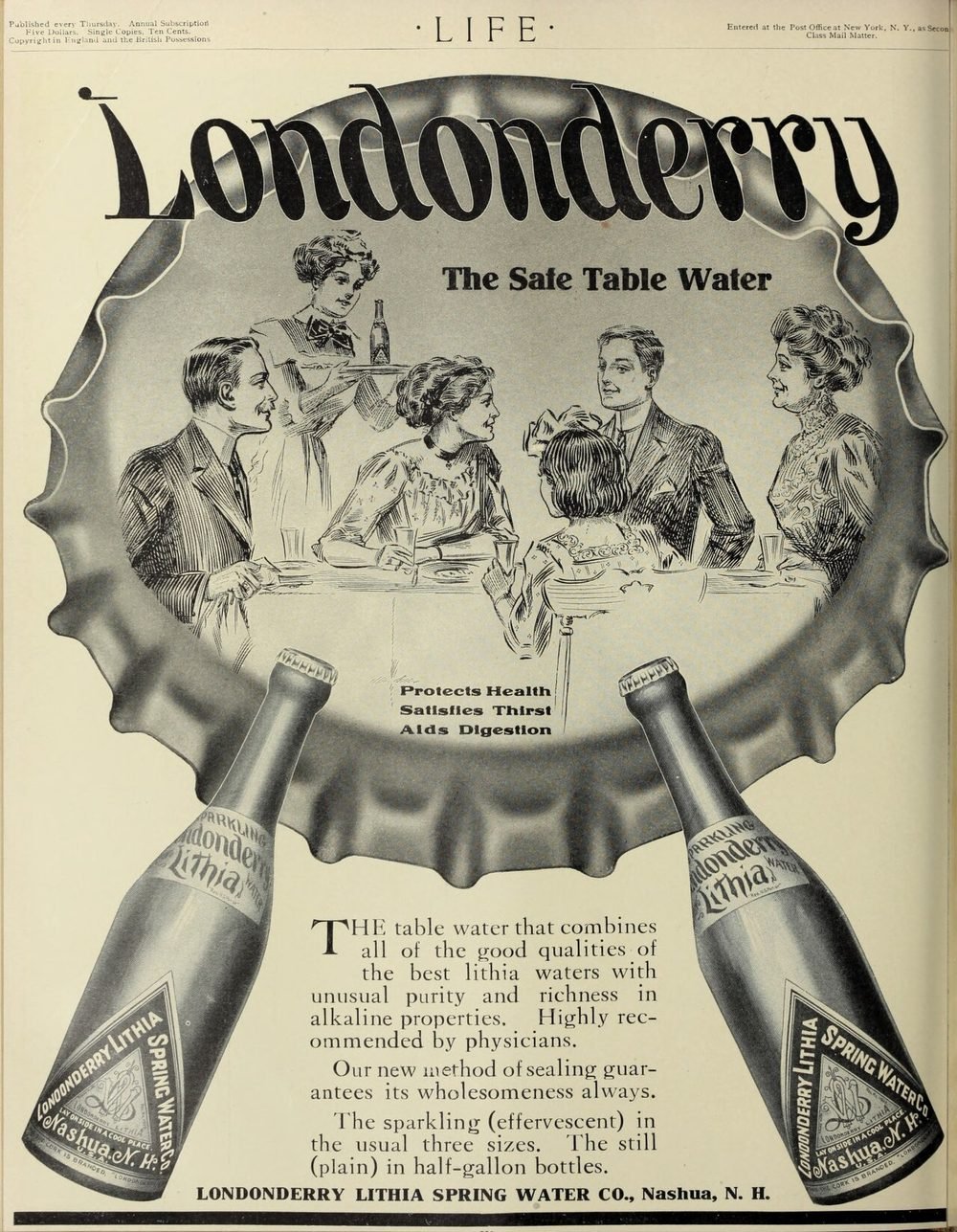
Plate 2.Lithia water was sold as a health tonic long before anyone measured lithium in the brain. Advertisement in Life, 1910.Public domainLondonderry Lithia Spring Water Co., 1910. Via Wikimedia Commons.
1
Donated brain tissue
Association only
What was found
Lithium was the only metal consistently low in brains with memory loss (Aron and colleagues, 2025).
What it means
Low lithium goes with the disease. That alone doesn’t show that adding lithium helps.
2
Mice
Strong lab science, not people
What was found
Cutting lithium from the diet sped up plaques, tau and memory loss. Adding low-dose lithium orotate reversed it.
3
Tap water
Mixed results
What was found
Denmark: the highest-lithium water went with 17% less dementia, but a middle band went with 22% more. Scotland: no benefit, and slightly higher risk in women.
4
Low prescription doses
Small trials, a modest signal
What was found
Brazil, 45 people with mild memory loss for 12 months: somewhat less decline. Pittsburgh’s LATTICE, 80 people for 2 years: missed its formal goals, though verbal memory declined about half as fast.
5
Orotate supplements
No human trial
What was found
Nothing yet in people. The dose that helped mice has not been translated into a safe human dose.
The “Harvard study” itself
Too early2/5Public / nonprofit
The “Harvard lithium study”: lithium deficiency and the onset of Alzheimer’s
Result Lithium was the only metal found consistently low in the brains of people with mild memory loss and Alzheimer’s. In mice, cutting dietary lithium sped up plaques, tau and memory loss. A tiny dose of lithium orotate in drinking water nearly prevented plaques and reversed memory loss in the mice. The senior author says people should not take lithium on their own until human trials find a safe, effective dose.
Who paid: National Institute on Aging; Ludwig, Glenn and Aging Mind foundations
Conflicts: Not reported
Dr. Yankner has been direct about what the study does not show. He told the Harvard Gazette that people should not take lithium compounds on their own, and that human trials are needed first. In his words: “Before recommending lithium orotate, we need to determine the effective and safe dose range in people.”
Claim check
Too early
What’s being said
“A Harvard study proved low-dose lithium reverses Alzheimer’s.”
Widely shared social-media videos, 2025
What the study actually shows
The reversal happened in mice. In people, the study measured lithium in donated brains after death. Nobody took lithium. The authors call for human trials before anyone takes it for memory.
Lithium in drinking water
If tiny amounts protect the brain, places with more lithium in the water might have less dementia. Two large studies tested that idea and pointed in opposite directions.
National case-control study (health and water records)
People
807,384
Length
Records study, no treatment period
Result People whose water had the most lithium had 17% less dementia. But people in a middle band had 22% more. With no clean dose pattern, the study cannot show that lithium in water protects the brain.
Who paid: Not reported on the pages we reached; water data from Geocenter Denmark
Conflicts: The lead author has consulted for Lundbeck, AstraZeneca and Sunovion.
Too early2/5Public / nonprofit
Lithium in Scottish tap water and dementia
Duthie A et al., International Journal of Geriatric Psychiatry 2023 Read the study
Design
Cohort study (health and water records)
People
37,597
Length
Records study, no treatment period
Result No link in men. Women living with higher lithium levels had somewhat more dementia (up to 17% higher risk), the opposite of the Danish result. Lithium in Scottish water is very low overall.
Who paid: No specific grant
Conflicts: Not reported
People who took prescription lithium
A records study looked at people who had been prescribed lithium for mental-health reasons. Two small trials then gave low prescription doses to people with mild memory loss.
Result Patients who had been prescribed lithium had about 44% less dementia than those who had not. The authors warn that this group differs from the general public and that the result should not be applied to everyone.
Who paid: UK Medical Research Council
Conflicts: Not reported
Promising3/5Public / nonprofit
Low-dose prescription lithium in mild memory loss (Brazil)
Forlenza OV et al., British Journal of Psychiatry 2011 Read the study
Design
Randomized, placebo-controlled trial
People
45 adults with mild cognitive impairment
Length
12 months
Result The lithium group had somewhat less memory decline and lower tau in spinal fluid than the placebo group. Blood levels were below the usual psychiatric range but far above anything a supplement pill provides.
Who paid: CNPq and FAPESP (Brazilian government research agencies); Alzheimer’s Association
Conflicts: Not reported
Didn’t work3/5Funder not confirmed
LATTICE: low-dose prescription lithium in mild memory loss (Pittsburgh)
Result The trial missed its formal goals. Verbal memory declined about half as fast on lithium (0.73 points a year vs 1.42 on placebo), just short of the strict bar the trial set. Kidney changes, diarrhea and tremor were more common on lithium, and older adults struggled with side effects above 300 mg a day.
Who paid: Not yet confirmed
Conflicts: Not reported
The LATTICE lead author summed it up: “Lithium doesn’t restore lost memory. What it appears to do, if the signal holds up, is slow deterioration.” Larger trials are the next step. Our clinical trials page explains how to find one.
Words used on this page
APOE4
A common version of a gene that raises the risk of Alzheimer’s. Carrying it does not mean someone will get the disease.
Control group
People in a study who don’t get the treatment, so their results can be compared with those who do. Without one, you can’t tell whether a change came from the treatment.
Case series
A report on a handful of patients who all got the same treatment, with no comparison group. Useful for ideas, weak as proof.
Preprint
A paper posted online before other scientists have reviewed it for a journal.
Ketogenic diet
A very low-carbohydrate, high-fat diet that makes the body burn fat for fuel and produce ketones.
SPECT
Single-photon emission computed tomography, a scan that shows blood flow in the brain using a small radioactive tracer.
Lithium orotate
A form of lithium sold as a dietary supplement without a prescription. It contains far less lithium per pill than prescription lithium carbonate, and it has not been tested for memory in people.